
In heavy cargo transportation and high-value industrial logistics, even minor damage or shipment loss can lead to significant financial impact. To address these challenges, the Smart Pallet shipping process has been adopted as a new operational standard.
Based on real operational experience at PCS Logistics, seamless coordination between digital platforms and on-site handling is critical to ensuring cargo safety and process transparency. This article provides a detailed breakdown of the six standard steps, helping enterprises maintain full visibility and control throughout the entire shipment journey.
1. Why standardization matters in the Smart Pallet shipping process?
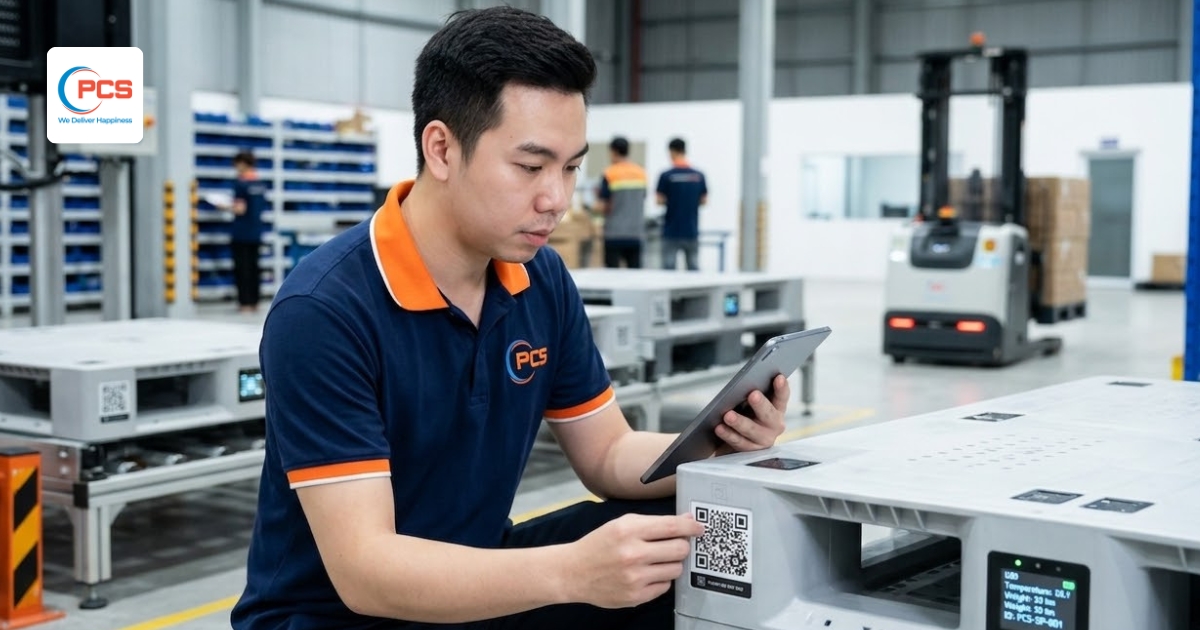
A Smart Pallet equipped with advanced microchip technology delivers value only when supported by a structured shipping process. Coordination between personnel, handling equipment, and management systems is essential to ensure consistent performance.
Based on practical deployment across industrial zones, PCS Logistics observes that process standardization significantly reduces operational risks. Every stage, including cargo consolidation, reinforcement, and document reconciliation, is digitized and integrated into a single system, enabling accurate data control and full shipment visibility.
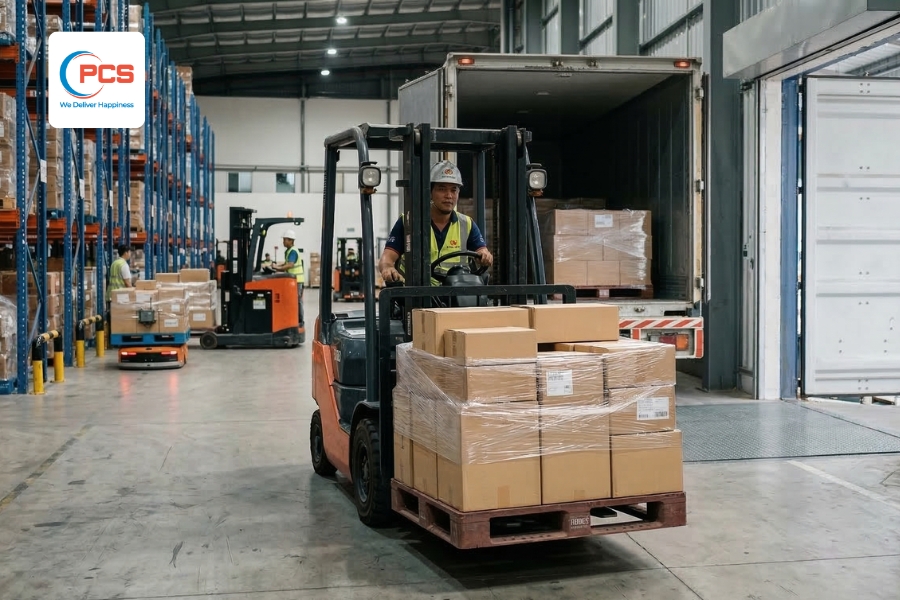
Cargo is reinforced and handled according to Smart Pallet standards before transportation
2. Smart Pallet Standard Operating Procedure
The Smart Pallet shipping process at PCS Logistics is structured, transparent, and aligned with strict operational standards. This system enables enterprises to connect, monitor, and control the full journey of heavy cargo with high accuracy.
Below is a detailed breakdown of the six operational steps:
Step 1: Solution consultation and connection
Enterprises can connect with PCS Logistics through official channels:
-
Hotline 1900 545 428
-
Email support@pcs logistics com
-
Website or Fanpage of PCS Logistics
Once requirements are received, PCS personnel assess cargo characteristics and operational needs. A suitable solution is proposed with clear planning on transit time, cost efficiency, and packaging standards.
Step 2: Customer account setup and order creation
To support centralized management, each enterprise is assigned a unique customer code.
This account allows:
-
Shipment tracking
-
Order management
-
Data and transaction control
Customers can create shipping orders directly within the system or receive support from PCS personnel.
Step 3: Order confirmation and operational planning
PCS Logistics reviews shipment details, confirms requirements, and provides a final quotation based on cargo weight, type, and transport route. After confirmation, pickup schedules are arranged, and suitable transport resources are assigned to ensure smooth execution.
Step 4: Pickup and pre-transport inspection
PCS personnel collect cargo directly at the designated location. Depending on operational requirements, cargo may be transferred to the Operations Center for inspection and reinforcement. Protection methods include palletization, wooden crating, and securing with high-strength materials to ensure compliance with international safety standards.
Step 5: Dedicated route transportation and handling
Cargo is transported via direct delivery or fixed routes connecting major industrial zones across the North Central and South regions. PCS Logistics provides handling equipment, such as forklifts and cranes, when required. This approach ensures stable handling and safe movement of heavy, oversized cargo.
Step 6: Delivery and digital document reconciliation
Cargo is delivered at the destination with a signed confirmation from the receiver. If required, PCS Logistics retrieves delivery records and updates digital documents within the system. This enables fast and transparent reconciliation for enterprise operations.
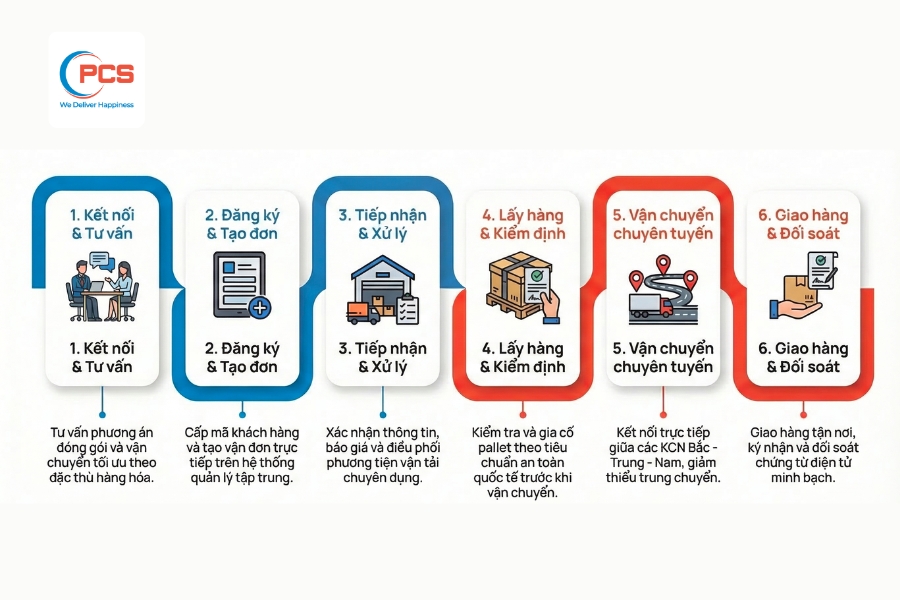
Standardized Smart Pallet shipping process improves cargo control and reduces risk
Throughout the Smart Pallet shipping process, enterprises are supported by PCS Logistics personnel, including sales, operations, and customer service. The system continuously updates shipment status in real time, allowing enterprises to maintain full visibility and control. This ensures cargo safety, predictable timelines, and transparent execution across the entire journey.
3. Smart Pallet shipping process for the textile and electronic industries
The Smart Pallet solution at PCS Logistics is developed with an agile approach to match the operational requirements of key industries. The standard 6-step Smart Pallet shipping process can be applied with adjustments based on cargo characteristics and production demands. Below is how the process supports the textile and electronic sectors in real operations.
3.1. Logistics challenges in the textile and electronic industries
-
Textile industry: Textile manufacturers frequently handle large volumes of raw materials across industrial zones such as Bac Ninh, Binh Duong, and Long An. Production schedules require precise delivery timelines, daily or weekly, to maintain continuous factory operations.
-
Electronic components and machinery: Electronic cargo and industrial equipment are high-value and are often transported in project-based shipments. These operations require strict safety standards, pallet-based storage, and detailed route monitoring for each unit.
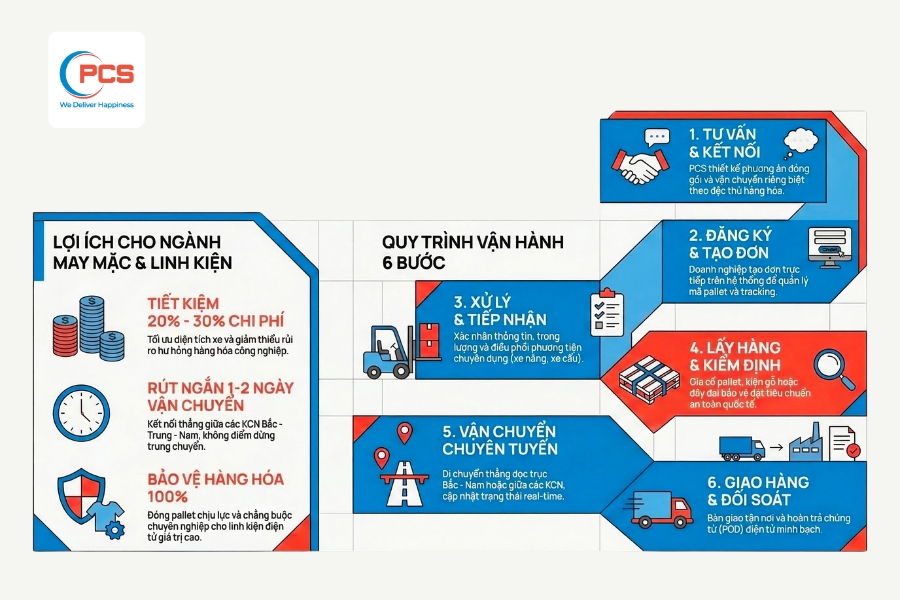
Smart Pallet shipping improves efficiency for textile and electronic industries
3.2. Advanced adaptation of the Smart Pallet shipping process for industrial operations
The standard Smart Pallet shipping process is applied with specific adjustments to match the operational characteristics of each industry. PCS Logistics ensures that every step aligns with production requirements, cargo structure, and delivery expectations.
-
Step 1 - Transport solution consultation: For textile enterprises, PCS Logistics recommends pallet-based transport to improve cost efficiency and maintain stable delivery schedules. For electronic cargo, the focus is on optimizing cargo space utilization and applying strict protection standards to ensure maximum safety.
-
Step 2 - Customer identification and order setup: Each enterprise is assigned a unique customer code for centralized management. Textile factories can schedule recurring daily orders, while electronic manufacturers can manage project-based shipments within a single system.
-
Step 3 - Order intake and scheduling: PCS Logistics receives shipment information and provides accurate delivery timelines. Direct transportation without intermediate handling points helps ensure materials and components arrive on schedule, supporting continuous production operations.
-
Step 4 - Specialized inspection and cargo reinforcement: This stage creates a clear operational advantage. Textile cargo such as fabric rolls and accessories, is organized on pallets to maintain structure and prevent compression. Electronic components are wrapped with protective materials, secured with high-strength bindings, and inspected to ensure full safety compliance before dispatch.
-
Step 5 - Dedicated route transport and equipment-based handling: Cargo moves continuously across industrial zones in North Central and South regions. Handling is performed using standard forklifts to maintain stability. The tracking system allows electronic manufacturers to monitor each shipment in real time and align production planning accordingly.
-
Step 6 - Delivery and digital document control: Cargo is delivered directly to factory locations with clear confirmation records. Digital documents are updated immediately within the system, allowing both textile and electronic enterprises to reconcile incoming materials quickly and with full transparency.
3.4. Operational impact of a standardized Smart Pallet shipping process
Implementing a structured Smart Pallet shipping process enables enterprises to improve resource efficiency and reduce logistics costs by up to 20 percent compared to conventional road transport.
Practical deployment at PCS Logistics delivers measurable results for FDI partners:
-
Advanex Vietnam achieved an 18 percent reduction in logistics operating costs
-
Tokyo Byokane Vietnam improved transit efficiency by 25 percent while reducing cargo damage risks
These outcomes demonstrate how a standardized process enhances operational stability and cargo protection across industrial supply chains.
4. Conclusion
The Smart Pallet shipping process represents a significant advancement in supply chain visibility and operational control. With a structured 6 step workflow, enterprises can maintain consistent cargo protection, accurate tracking, and transparent execution.
For enterprises seeking a reliable pallet-based shipping solution for industrial cargo, PCS Logistics provides an agile and well-coordinated approach aligned with production requirements.
Contact PCS Logistics to explore Smart Pallet shipping that supports your operational goals with improved visibility, cargo safety, and predictable delivery performance.
-
Hotline 1900 545 428
-
Email support@pcs logistics com