
The China+1 strategy is driving the expansion of manufacturing networks in Vietnam, particularly in industrial parks across the southern region. Businesses continue to maintain their supply chains in China while establishing additional manufacturing facilities in Vietnam. As a result, demand for transporting raw materials, components, machinery, and distributing finished products is growing in both volume and complexity.
In this context, industrial parks in Ho Chi Minh City, Dong Nai, and Tay Ninh serve as important connections between manufacturing activities, Vietnam–China trade, and domestic logistics networks.
1. Southern Vietnam's industrial parks in the China+1 trend
China+1 is a strategy aimed at diversifying manufacturing locations. Under this approach, businesses maintain their operations in China while expanding into other countries to improve supply chain flexibility and reduce dependence on a single market.
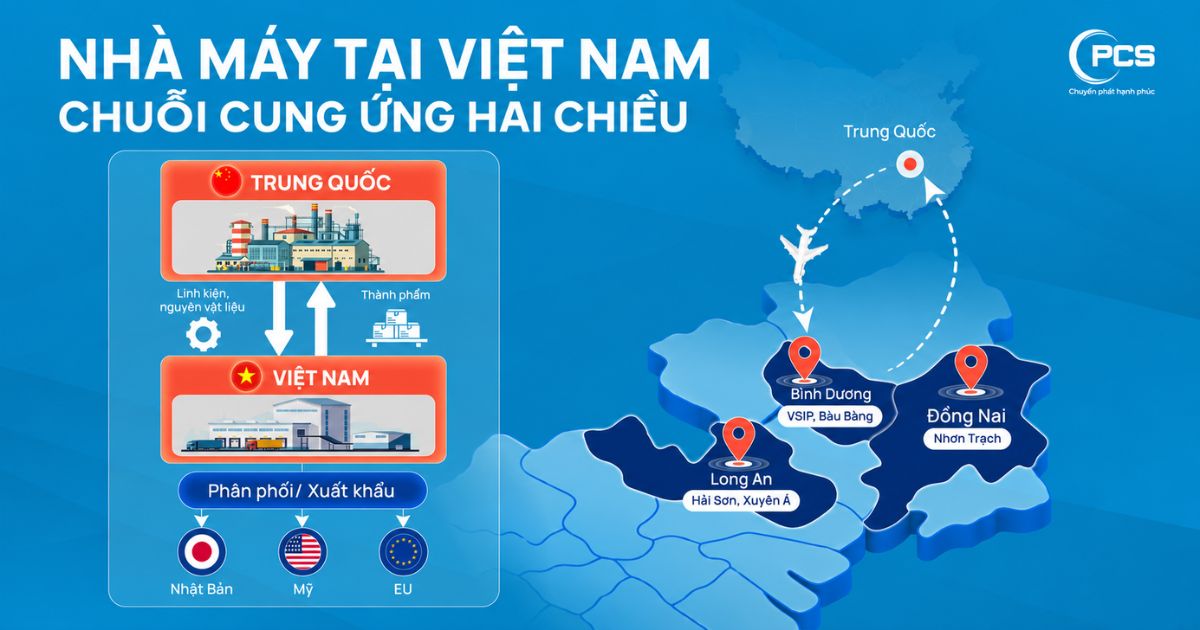
Southern Vietnam offers advantages in industrial park infrastructure, transportation networks, and access to international seaports and airports. Three notable manufacturing areas include:
-
Ho Chi Minh City (formerly Binh Duong Province): Industrial parks such as VSIP, My Phuoc, and Bau Bang form a diversified manufacturing network covering electronics, mechanical engineering, industrial equipment, and supporting industries.
-
Dong Nai Province: Industrial parks in Nhon Trach benefit from connections to central Ho Chi Minh City, the Cai Mep–Thi Vai port complex, and regional logistics centers, supporting manufacturing and import-export activities.
-
Tay Ninh Province (formerly Long An Province): Hai Son and Xuyen A industrial parks in the Duc Hoa area are located near Ho Chi Minh City and regional transportation routes, serving manufacturing, warehousing, and distribution needs.
These industrial clusters are developing an interconnected supply network linking suppliers, factories, warehouses, and end markets. This network also provides a foundation for the growth of international transportation and domestic logistics services.
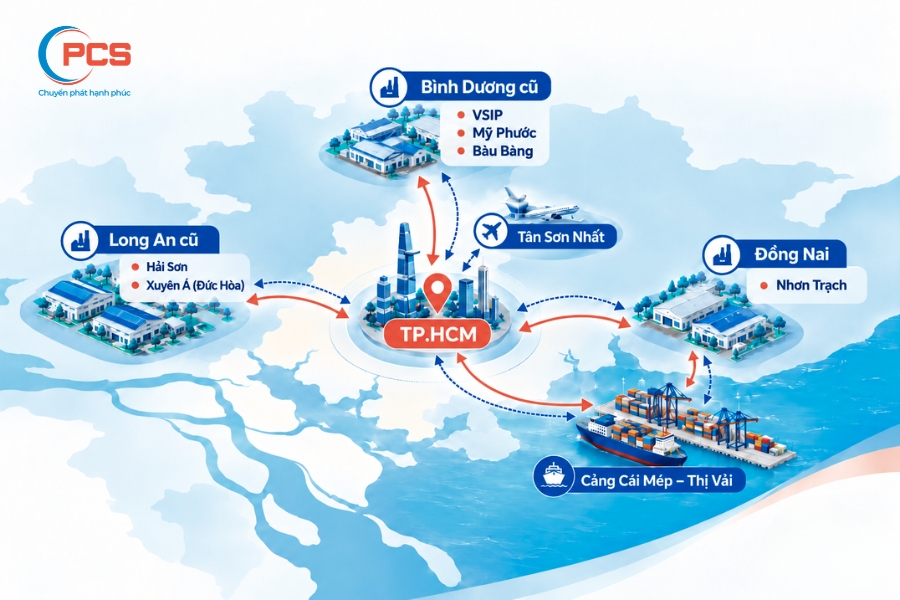
Industrial parks in Ho Chi Minh City, Dong Nai, and Tay Ninh are within the China+1 supply chain.
2. From Chinese suppliers to industrial parks in Vietnam
Under the China+1 model, China remains a major source of raw materials, components, and manufacturing equipment. For businesses in the electronics, high-tech, automotive, and automotive parts industries, goods typically move through three key logistics stages.
2.1. Vietnam–China Freight Transportation
Under the China+1 model, goods move in both directions between Vietnam and China. For imports, components, raw materials, and machinery are transported from China to manufacturing facilities in Vietnam. For exports, semi-finished and finished products manufactured in Vietnam are shipped to China.
This two-way flow of goods is one reason why Vietnam–China air freight services are attracting growing interest from manufacturing businesses.
For urgent shipments supporting manufacturing operations, daily direct flights connect Guangzhou and Shanghai with Ho Chi Minh City. On the Shanghai–Ho Chi Minh City route, cargo may arrive in Ho Chi Minh City on the same day, depending on flight schedules and actual handling times.
PCS Logistics' Vietnam–China freight service supports businesses at both ends of the route through:
-
Partner networks in Guangdong and Shanghai: Domestic cargo pickup and delivery within China.
-
Customs clearance support in Vietnam and China: Available for businesses with the required import-export licenses.
-
Shipment-specific flight arrangements: Suitable for cartons, loose cargo, pallets, and machinery.
-
Value-added services: Delivered Duty Paid (DDP) arrangements, including applicable import duties and taxes, as well as repacking in accordance with airline requirements.
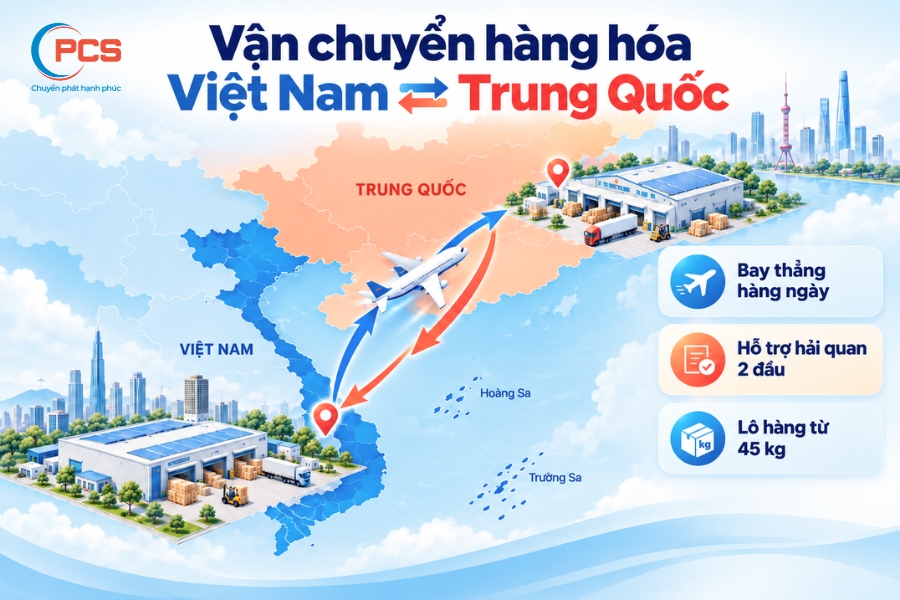
Two-way Vietnam–China air freight transportation connecting Ho Chi Minh City with Guangzhou and Shanghai.
PCS Logistics' Vietnam–China air freight service is suitable for shipments weighing 45 kg or more, particularly components, automotive parts, raw materials, and other manufacturing-related goods.
To support timely transportation, businesses should consider the following:
-
Book in advance: Carton shipments should generally be booked 1–3 days ahead. Palletized cargo or shipments during peak seasons should be booked 3–5 days in advance.
-
Provide accurate cargo dimensions: Packages taller than 110 cm and palletized shipments should be checked in advance to determine suitable aircraft capacity.
-
Prepare consistent shipping documents: Information on commercial invoices, packing lists, and related documents should match to facilitate cargo handling and customs clearance.
Businesses requiring freight transportation between Vietnam and China can provide PCS Logistics with their pickup location, cargo dimensions, weight, and required delivery date. PCS will check actual flight availability and recommend a suitable transportation option for each shipment.
2.2. Road transportation to factories and between industrial parks
Following international transportation, goods are delivered to factories, raw material warehouses, or processing facilities within industrial parks. Businesses can choose Full Truckload (FTL) transportation for larger shipments that require greater control over delivery schedules, or Less-than-Truckload (LTL) transportation for smaller shipments and periodic replenishment. The appropriate option depends on cargo volume, transportation routes, and shipment frequency.
2.3. Finished goods distribution to B2B customers
After manufacturing, finished products are transported to central warehouses, distributors, dealers, showrooms, or other business customers. For distribution networks involving multiple delivery points, transportation needs to be organized according to receiving schedules, documentation requirements, and each customer's supply plan.
These three logistics stages are closely connected. The arrival of raw materials affects manufacturing schedules, while transportation coordination and distribution planning determine when goods reach customers.
3. PCS Logistics connects international freight and domestic distribution
To meet the demand for moving goods between China and industrial parks in Vietnam, PCS Logistics works with businesses to develop transportation solutions for each stage of their supply chains.
-
Vietnam–China Freight Transportation: Two-way air freight between Ho Chi Minh City and Guangzhou or Shanghai, with support covering cargo pickup, customs procedures, and delivery.
-
Road Transportation: Full Truckload (FTL), Less-than-Truckload (LTL), and interprovincial transportation connecting factories, industrial parks, warehouses, and distribution centers.
-
B2B Distribution Logistics: Transportation to dealer networks, distributors, showrooms, and business customers, with arrangements based on cargo volume, delivery areas, and receiving schedules.
When international freight, road transportation, and domestic distribution are coordinated, businesses can better plan their supply activities, minimize disruptions between logistics stages, and maintain greater visibility over delivery progress.
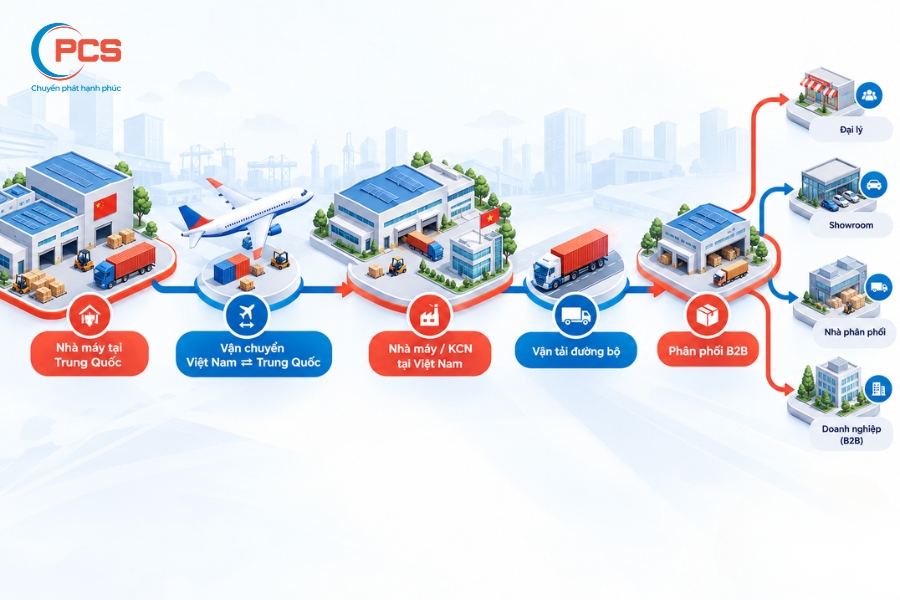
PCS Logistics' connected service flow, from Vietnam–China air freight to domestic road transportation and B2B distribution.
4. Building a more proactive supply chain under China+1
Industrial parks in Southern Vietnam are supporting the expansion of freight flows between Vietnam and China, creating additional demand for domestic transportation and B2B distribution services. For manufacturing businesses, selecting logistics solutions that match cargo characteristics, production schedules, and customer networks is essential to maintaining a stable supply chain.
PCS Logistics is ready to support businesses with Vietnam–China freight transportation, nationwide road transportation, and B2B goods distribution.
Contact PCS Logistics for transportation and distribution solutions suited to your business needs.
-
Hotline: 1900.545.428
-
Website: pcs-logistics.com
-
Email: support@pcs-logistics.com