
Lost customs declaration is an unexpected issue that can pose significant risks to import-export businesses. A customs declaration is one of the most important documents used for customs clearance procedures, tax finalization, and tax refund applications. So, how should businesses respond when this situation arises to minimize operational and legal risks? This article provides practical guidance based on current customs regulations.
Regulations on customs declaration storage
A customs declaration is a core document in customs documentation and carries significant legal weight in import-export cargo management. Under current regulations, businesses are responsible not only for accurate customs declarations but also for maintaining complete customs records within the legally required retention period.
According to Point d, Clause 2, Article 18 of the 2014 Customs Law No. 54/2014/QH13, customs declarants are obligated to:
“Retain customs records for goods that have been customs cleared for 05 years from the customs declaration registration date, unless otherwise provided by law...”
Maintaining complete customs documentation helps businesses manage tax audits, finalization procedures, and issues related to import-export operations more effectively.
How does losing a customs declaration affect businesses?
A customs declaration plays an important role throughout import export procedures. It serves as a legal basis for customs authorities to inspect cargo, determine tax obligations, and implement government management measures.
When a customs declaration is lost, businesses may face several consequences, including:
-
Disruptions to customs clearance procedures
-
Difficulties with tax finalization and tax refund procedures
-
Additional processing time with customs authorities
-
Increased risk of administrative penalties
In particular, losing an original paper customs declaration used for tax and customs settlement procedures may directly affect a company’s legal and financial interests during post-clearance audits.

A lost customs declaration may affect customs processing and business operations.
For urgent shipments, especially international express cargo, business documents, or industrial components, missing customs documentation may also affect delivery schedules and operational planning. As a result, many businesses today prefer integrated logistics solutions that support customs documentation and clearance procedures to reduce operational risks during transportation.
Readers can learn more about PCS Logistics' priority international express service to Japan to better understand how urgent shipments are handled between Vietnam and Japan.
Detailed guidance for handling a lost customs declaration
Depending on whether the business uses electronic or paper customs declarations, the handling process may vary significantly.
For electronic customs declarations on the VNACCS system
In today’s digital customs environment, electronic customs declarations help businesses significantly reduce the risk of document loss. If a business loses the printed copy of an electronic customs declaration, it can simply log back into the VNACCS system and reprint the declaration without complicated explanation procedures.
According to Point a.1, Clause 1, Article 52 of Circular 38/2015/TT BTC issued by the Ministry of Finance, for customs cleared cargo, customs declarants only need to print the container list or cargo list from the electronic customs portal or declaration system for presentation to customs officers during cargo supervision.
This regulation allows businesses to manage customs data more efficiently while reducing the risk of lost paper documents.
For the original paper, customs declarations
If a business loses an original paper customs declaration used for tax finalization or refund procedures, the handling process becomes more strict and requires direct coordination with customs authorities.
Businesses should complete the following steps:
-
Immediately notify the customs sub-department: Businesses should promptly inform the Customs Sub-Department where the declaration was registered to receive guidance based on the specific situation.
-
Prepare an explanation letter: Businesses must provide a written explanation clearly stating the reason for the lost declaration and committing to cooperate with customs authorities during the verification and handling process.
Request customs record extraction: Businesses must work directly with the Customs Sub Department responsible for storing the original records in order to complete customs declaration extraction procedures and resolve related administrative matters.
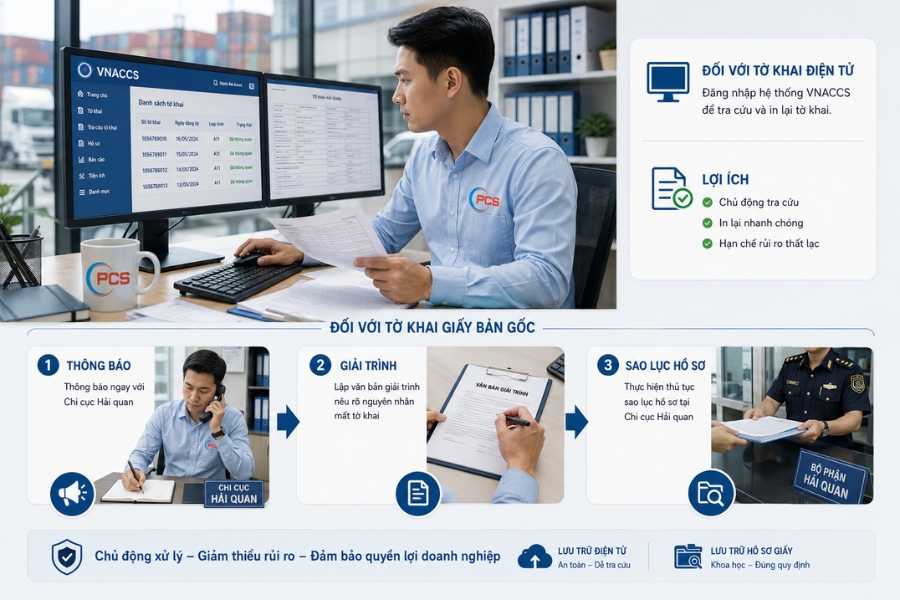
Proper handling procedures help businesses reduce legal risks related to lost customs declarations.
Legal consequences if the original customs declaration cannot be recovered
If the original customs declaration cannot be found, businesses may face several serious legal consequences.
-
Nationwide public announcement: Local customs departments may announce information on lost customs declarations through official channels in accordance with regulations.
-
The customs declaration loses legal validity: After confirming the loss, customs authorities may notify local tax authorities. The lost declaration will no longer carry legal validity for tax finalization or tax refund procedures.
-
Administrative penalties: Businesses may also face administrative penalties for failing to comply with customs documentation retention obligations under customs regulations.
Solutions to prevent customs declaration loss risks
To minimize the risk of lost customs documentation, businesses should proactively establish structured document management and storage procedures.
Prioritize electronic customs declarations
Using the VNACCS system securely stores customs data within the electronic customs system, helping businesses access and manage records more efficiently.
Organize customs documentation properly
Businesses should store paper documents in secure locations protected against humidity, fire risks, and physical damage while complying with the minimum 5 year retention period required under the 2014 Customs Law.
Create multiple backup copies
After completing customs clearance procedures, businesses should scan or photocopy important documents such as:
-
Customs declarations
-
Bills of Lading
-
Commercial Invoices
-
Certificates of Origin
-
Other supporting customs documents
Maintaining both physical and digital copies helps businesses respond more effectively to unexpected operational issues.

Organized document storage helps businesses reduce customs documentation risks.
Conclusion
Lost customs declaration is a sensitive legal issue that may directly affect import export operations, tax finalization activities, and tax refund procedures. Understanding customs regulations, maintaining structured document storage procedures, and prioritizing electronic customs declarations can help businesses significantly reduce operational risks.
As logistics operations and customs compliance requirements continue to demand greater accuracy, businesses should also partner with experienced logistics providers to enhance support for customs documentation, clearance procedures, and international transportation services.
For consultation on international shipping solutions for businesses, please contact PCS Logistics:
-
Hotline: 1900 545 428
-
Email: support@pcs-logistics.com