
During import-export procedures, every customs declaration goes through multiple stages, including registration, clearance, and cargo supervision. However, for a declaration to be fully completed from a customs management perspective, its status must be properly updated in accordance with the regulations. Customs declaration liquidation is the step that closes this management lifecycle.
Understanding the concept, timing, and related considerations helps businesses manage documentation more effectively while maintaining consistent, compliant import-export procedures.
1. Customs declarations and the lifecycle of a shipment
According to the 2014 Customs Law and related regulations such as Decree 08/2015/ND CP, Circular 38/2015/TT BTC amended by Circular 39/2018/TT BTC, a customs declaration serves as the legal basis for customs authorities to supervise, inspect, and manage import export shipments.
Businesses may also refer to related articles about what a customs declaration is and how to open a customs declaration to better understand the operational role of customs documentation within import export activities.
From an operational perspective, a customs declaration typically goes through the following stages:
-
Cargo inspection and customs channel classification
-
Customs clearance or cargo release
-
Cargo supervision through customs controlled areas
-
Documentation retention for post clearance audits
Customs declaration liquidation is generally associated with the final confirmation stage within this process.

Customs declarations play a central role throughout the customs clearance and cargo supervision process.
2. What is customs declaration liquidation?
Customs declaration liquidation refers to the completion of the customs management status of a declaration after goods have physically passed through customs supervision areas or after businesses have fulfilled their management obligations under the declared customs category.
Depending on the situation, customs declaration liquidation may involve two main scenarios:
2.1. Confirmation that goods have passed through customs supervision areas
For export shipments, after customs clearance, goods must pass through customs supervision areas at ports, border gates, bonded warehouses, or designated cargo consolidation locations, as required by regulations.
When the customs system records the status as “goods passed through customs supervision,” the declaration is considered fully completed from a customs supervision perspective. Regulations on cargo supervision responsibilities are provided in Circular 38/2015/TT BTC and its amendments, as well as Circular 39/2018/TT BTC.
2.2. Completion of settlement obligations for processing and export manufacturing activities
For businesses operating under processing or export manufacturing models, customs declarations are also linked to settlement reporting obligations related to imported raw materials, supplies, and exported products.
After settlement reports are submitted and approved by customs authorities in accordance with Circulars 38 and 39, the related declarations are considered to have completed their management obligations under the declared customs category as part of the customs declaration liquidation process.
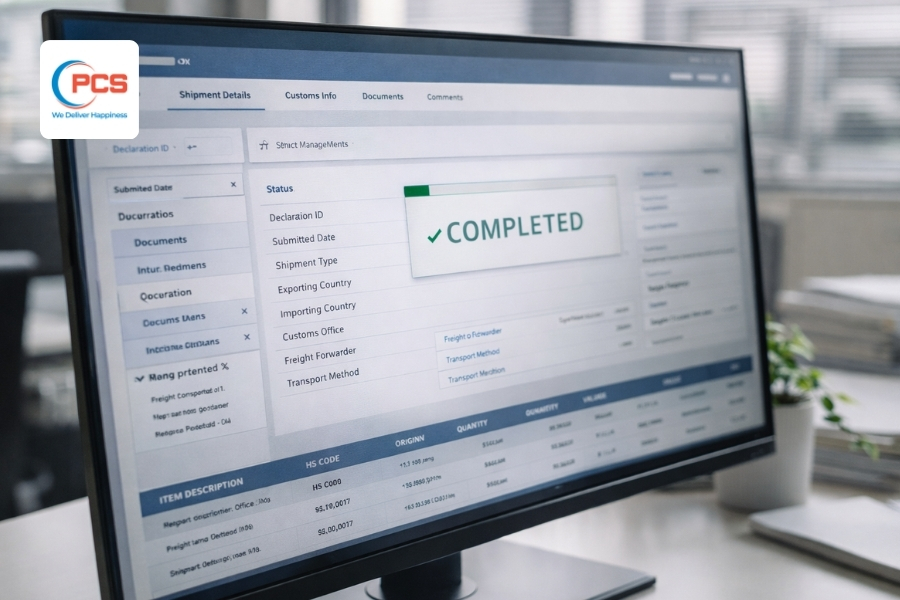
Customs declaration liquidation is the final confirmation step after customs management obligations have been fully completed.
3. Differences between customs declaration, liquidation, customs clearance and customs declaration cancellation
During import export procedures, the concepts of customs clearance, customs declaration liquidation and customs declaration cancellation often appear within the same customs documentation lifecycle. However, each stage carries a completely different legal and operational meaning. Understanding these differences helps businesses process documentation accurately and avoid confusion during implementation.
-
Customs clearance is the first major milestone. This is the point at which customs authorities approve goods for export or import after completing document inspections and verifying compliance requirements. Once a declaration is cleared, the shipment is eligible to proceed under the transportation plan.
-
Customs declaration liquidation is the final completion step that follows. It is used to confirm that goods have physically passed through customs supervision areas or that businesses have fulfilled management obligations under the declared customs category. This can be understood as the final stage that closes the management status of the declaration within the customs system.
-
Customs declaration cancellation is a different situation. When errors occur or shipments are no longer processed, businesses must complete cancellation procedures to terminate the validity of previously registered declarations. Canceling a customs declaration does not mean the export process has been completed. Instead, it refers to handling declarations that are no longer valid for use.
If customs clearance is considered the “opening stage” for a shipment, then customs declaration liquidation represents the “management completion stage,” while customs declaration cancellation refers to the “termination of declaration validity.” Understanding each concept correctly helps businesses manage the declaration lifecycle more effectively and maintain consistent customs compliance procedures.
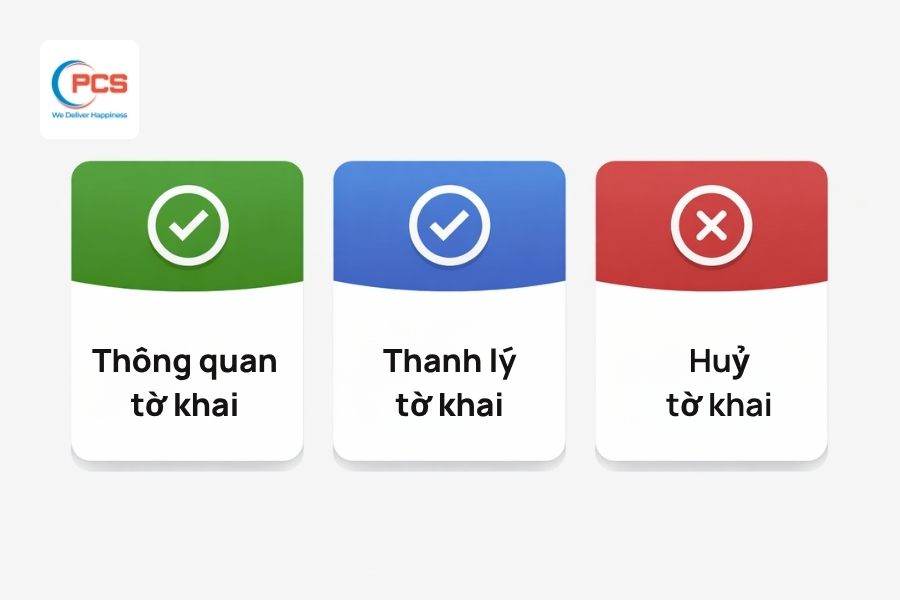
Customs clearance, customs declaration liquidation, and customs declaration cancellation represent different stages within the customs documentation lifecycle of a shipment.
4. When do businesses need to perform customs declaration liquidation?
Customs declaration liquidation usually arises when businesses need to update the customs management status of a shipment within the customs system, ensuring that documentation accurately reflects actual import/export activities. Below are two common situations.
4.1. Case 1: Goods have been cleared but have not been confirmed through customs supervision areas
In practice, a customs declaration may already be cleared, meaning the shipment is eligible for export or import procedures. However, if the system has not yet recorded the status confirming that goods have passed through customs supervision areas, the management lifecycle of the declaration is not considered fully completed.
In this situation, businesses should review the declaration data and coordinate with warehouses, ports, or customs officers to update the correct status within the system. Timely confirmation helps maintain consistency between customs declaration data and actual transportation activities.
4.2. Case 2: Completion of settlement obligations for processing and export manufacturing activities
For businesses operating under processing or export manufacturing models, customs declaration liquidation is also associated with settlement reporting obligations under Circulars 38/2015/TT BTC and 39/2018/TT BTC.
Businesses are required to consolidate and reconcile import, export, and inventory data related to raw materials, supplies, and products associated with registered customs declarations. Once settlement reports are completed and aligned with declared customs data, the management obligations of related declarations are considered fully completed.
5. Customs declaration liquidation process
In essence, customs declaration liquidation is the process of confirming that a customs declaration has fully completed its management obligations according to regulations. Depending on the import export category, procedures may vary. However, for standard export shipments, the basic process typically includes the following steps:
-
Checking declaration status: After customs clearance is completed, businesses should review the declaration status within the customs system to ensure that goods have been recorded as passing through customs supervision areas. This is an important condition for completing the declaration lifecycle.
-
Reconciling cargo information: Businesses should ensure that actual shipment details, such as container numbers, cargo quantity, and transportation information, are consistent with declared customs data. Data discrepancies may prevent the declaration from being confirmed as completed.
-
Confirmation through customs supervision areas: Goods must pass through customs-controlled areas in accordance with the Customs Law and related regulations, such as Circulars 38/2015/TT BTC and 39/2018/TT BTC. Once the system records the cargo supervision status, the declaration is considered fully completed from a customs management perspective.
-
Documentation retention: After completing customs declaration liquidation, businesses should retain customs declarations and related supporting documents for post-clearance audits or settlement reporting purposes when required.
6. Final Thoughts
Understanding customs declaration liquidation and regularly monitoring declaration status helps businesses complete documentation properly after customs clearance is finished. This is an important step for maintaining consistency across customs data systems while supporting tax reconciliation and import/export documentation management.
PCS Logistics provides professional international logistics services, supporting businesses in optimizing cargo movement processes and maintaining documentation consistency throughout import export operations. Businesses requiring consultation for international transportation solutions and specialized customs compliance support may contact PCS Logistics for timely assistance:
-
Hotline: 1900.545.428
-
Email: support@pcs-logistics.com