

In the era of Industry 4.0, data transparency is the most valuable asset for any enterprise. Understanding how do smart pallets work is not just a technical curiosity; it is the definitive answer to optimizing supply chain management. This system transforms a conventional, passive pallet into a dynamic data source capable of continuous, real-time communication.
1. Smart Pallet operational mechanism
To fully understand how do smart pallets work, we need to dive into the closed-loop data processing system, where each pallet is no longer an inanimate object but becomes an intelligent digital assistant through three primary stages:
1.1. Data Collection
At the foundational level, compact but extremely durable IoT devices such as RFID tags, GPS modules, or multi-layered sensor systems are integrated directly and synchronously into the pallet's body.
These devices act as the pallet's digital eyes and ears, allowing it to perceive its own existence and status. The system continuously monitors and records real-time data, including: precise location coordinates, movement status, and dwell time, accurate to the second. It even withstands harsh environmental conditions, such as temperature and humidity fluctuations, as well as sudden shocks and impacts during loading and unloading.
1.2. Data Transmission
After collection, the data needs a digital highway to travel to the operations center. Smart pallets use ultra-low-power wireless networks such as 4G/5G mobile networks, Wi-Fi, Bluetooth, or, specifically, the LoRaWAN standard.
Choosing these protocols ensures a continuous flow of information, transmitting real-time updates whether the goods are in a closed warehouse or traveling cross-border. The biggest advantage of this phase in explaining how smart pallets work is that it does not deplete the battery, allowing sensors to operate reliably for many years without maintenance.
1.3. Data Analysis
To truly understand how do smart pallets work, we must look at how raw field data is aggregated into a central cloud platform or specialized analytical software. This serves as the "brain" of the entire system.
At this stage, intelligent algorithms process data in an instant, converting raw numbers into actionable, practical insights. The system can automatically trigger smart alert scenarios when anomalies are detected, from sudden temperature spikes that endanger cold-chain products to pallets deviating from intended routes or sustaining heavy impacts beyond safety thresholds.
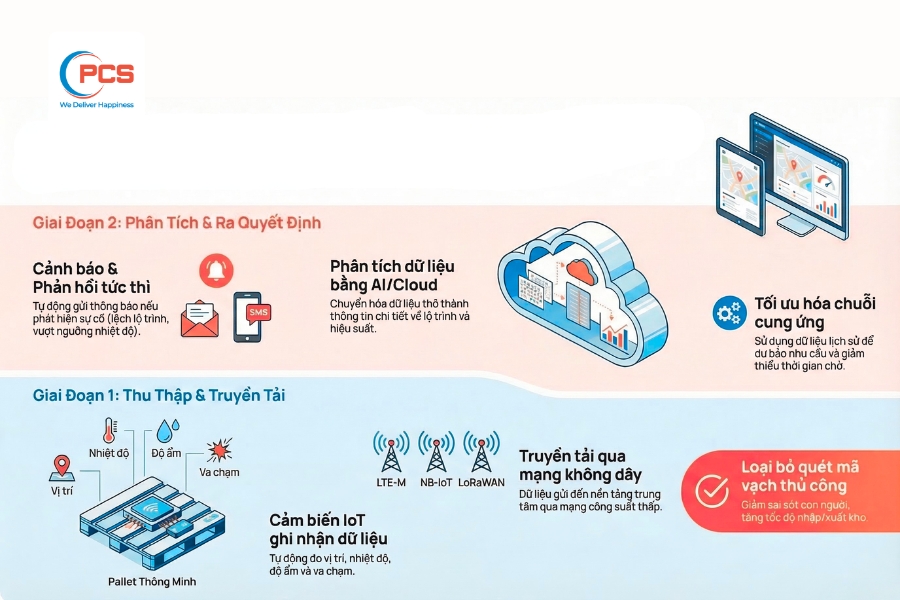
Operational model and automated data analysis of the Smart Pallet system.
By mastering the operational logic of how do smart pallets work, businesses can eliminate manual barcode scanning and cumbersome paperwork. Instead of waiting for staff to scan codes, the pallet automatically reports its position and status to Warehouse Management Systems (WMS), Transportation Management Systems (TMS), or ERP platforms. Consequently, inventory levels are automatically updated, and autonomous robots or self-driving forklifts within the warehouse have precise data on pallet locations, enabling them to move and handle goods seamlessly.
2. Intelligent Response Scenarios of the Smart Pallet System
The defining advantage of a high-tech logistics solution is its ability to record and notify automatically. To grasp how do smart pallets work in a practical sense, one must look at how the system transitions from reactive to proactive risk management, addressing issues as soon as they arise rather than after the journey ends.
2.1. High Temperature Spikes
For sensitive goods such as cold-chain food, pharmaceuticals, or fresh flowers, maintaining a stable temperature is the top priority. Environmental sensors integrated into the pallet continuously measure temperature levels. Upon detecting a breach of safe thresholds or a sudden temperature spike, the IoT device immediately transmits data wirelessly to trigger automated alerts via SMS, email, or the central management system.
With this real-time visibility, warehouse managers can intervene instantly such as relocating the shipment to a cooling zone before spoilage occurs. This maintains cold-chain integrity, prevents financial waste from damaged goods, reduces insurance claims, and ensures product quality for the end consumer.
2.2. Strong Physical Shocks
During long-haul transportation, cargo may encounter unexpected collisions or rough handling. This is precisely where the mechanism of how do smart pallets work proves most effective in asset protection. Shock sensors act as the "digital eyes and ears" of the shipment, instantly recording any abnormal force, drops, or severe shocks during transit. Detailed impact data, including time and location, is transmitted directly to the analytics platform.
Management teams are notified of incidents in real-time to assess potential damage and implement corrective measures. Over the long term, these reports help businesses identify recurring patterns of mishandling or accurately assign accountability to carriers or warehouses. This leads to improved operational workflows and significantly reduced costs for pallet and cargo replacements.
2.3. Route Deviations
Ensuring that goods follow the correct path and direction is a core factor in achieving on-time and safe delivery. To understand how do smart pallets work in terms of security, we must look at their smart GPS positioning capabilities; the pallet always knows exactly where it is on the map. If a delivery vehicle suddenly deviates from its intended route or leaves a "safe zone," the pallet will immediately "speak up" by sending a real-time alert to the operations center.
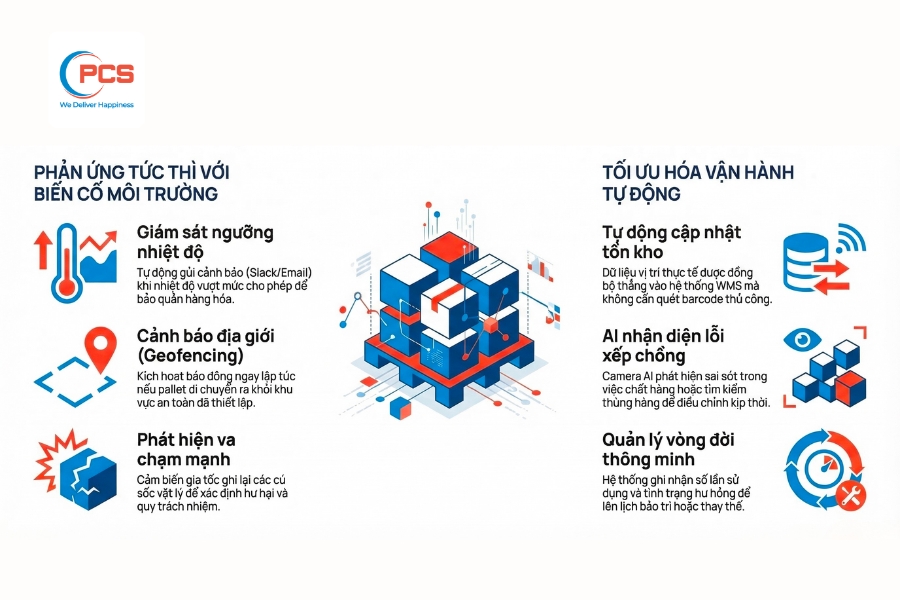
Integrated smart monitoring and automated operation features of the Smart Pallet system.
This information enables prompt communication with the driver to provide support or resolve issues that arise on the road. Consequently, businesses can enjoy total peace of mind knowing their cargo remains on the right track, avoiding losses or misdeliveries and maintaining a solid reputation with all partners.
Optimizing the Smart pallet transport service in Vietnam not only reduces operational risks but also leads to significant cost savings for the supply chain. If you are looking for a transparent, modern Pallet logistics service in Vietnam, PCS Logistics is the ideal partner to help you achieve that goal.
3. How can Smart Pallets reduce cargo shrinkage?
Smart pallets significantly minimize cargo shrinkage and theft by providing a transparent and continuous stream of data throughout the supply chain. To understand how do smart pallets work in reducing loss, we can look at the following specialized mechanisms:
3.1. Real-Time Location Tracking and Instant Alerts
Blind spots in traditional supply chains are a primary reason why millions of pallets and goods are lost or stolen each year. Smart pallets solve this by continuously reporting their precise coordinates. If a pallet deviates from its planned route or leaves a designated safe zone (geofencing), the system immediately triggers an alarm, allowing security teams to respond and intervene before the asset is truly lost.
3.2. Enhanced Transparency and Accountability
With traditional pallet systems, it is often difficult to determine who is at fault when goods disappear. Smart pallets address this by digitally recording every movement and handling event. Having all parties—suppliers, carriers, and warehouse operators operate on a single source of truth enhances accountability and eliminates "blame-shifting" when incidents occur.
3.3. Eliminating Mis-delivery Errors
A significant portion of inventory loss occurs when goods are delivered to the wrong address or contain the incorrect product mix. By automating inventory updates and cross-referencing information in real-time without the need for manual barcode scanning, smart pallets minimize human error, ensuring cargo reaches the correct destination every time.
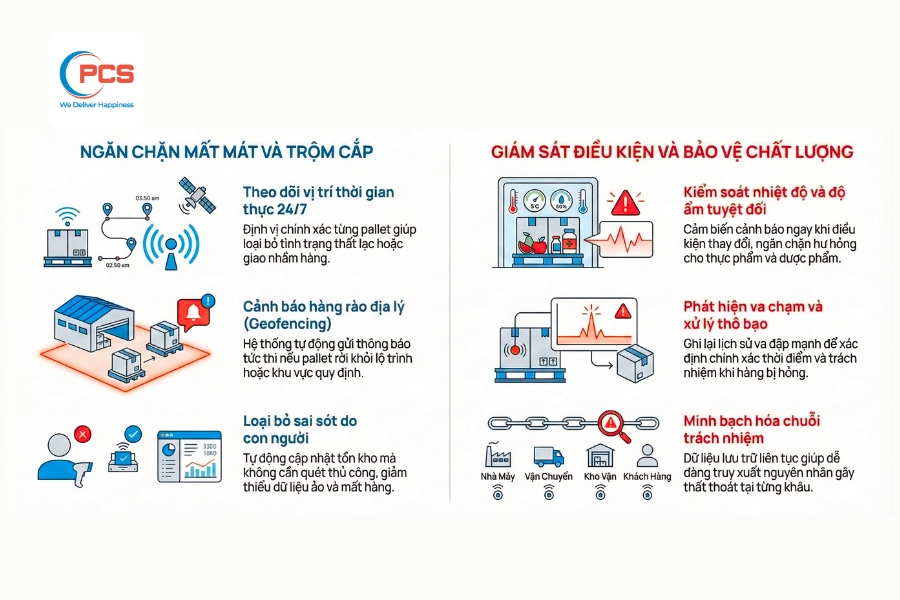
Integrated loss prevention and real-time monitoring via the Smart Pallet system
3.4. Reducing loss from spoilage
Shrinkage is not caused solely by theft; it also results from cargo damage during transit, particularly for food and pharmaceuticals. Understanding how do smart pallets work to prevent spoilage involves looking at their environmental sensors. These sensors continuously monitor temperature, humidity, and physical shocks, enabling managers to make timely adjustments before the goods perish, thereby drastically reducing waste.
3.5. Identifying error patterns for long-term prevention
Beyond immediate incident response, data from smart pallets helps managers identify risk patterns or specific areas where incidents frequently occur (specific route prone to theft or impact). With these insights, businesses can establish new protocols and workflows to prevent recurring issues.
Thanks to these advanced capabilities, businesses, especially those in the retail and FMCG sectors, can maintain more accurate inventory control, proactively prevent asset loss, and significantly boost their profit margins.
4. Conclusion
Understanding how do Smart Pallets work is essential for enterprises moving toward a more digital and data-driven supply chain. PCS Logistics solutions enhance transparency, improve cargo protection, and support cost efficiency, helping businesses strengthen operational performance and build long term competitive advantage.