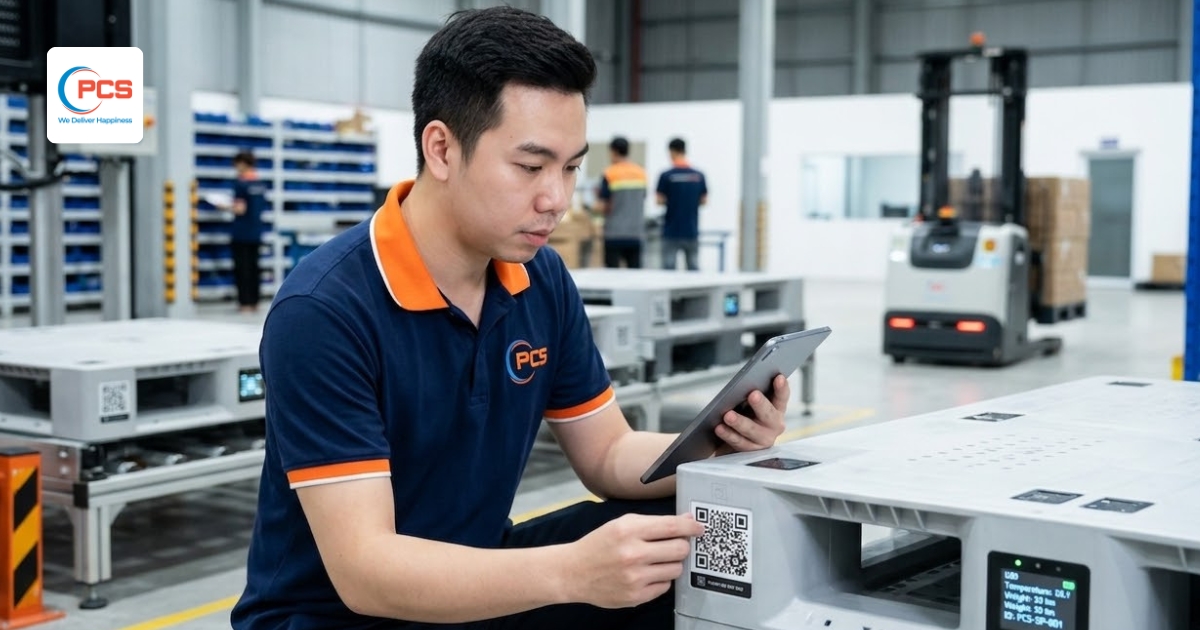

In the era of globalization and rapid e-commerce expansion, many industry leaders are asking: What is smart pallet, and how can it redefine modern supply chains? As the logistics industry faces immense pressure to undergo digital transformation, one of the most critical yet often overlooked components in this chain is the pallet. From primitive wooden platforms, the emergence of the Smart Pallet has marked a major turning point, transforming a passive load carrier into an active, intelligent data-transmitting device.
1. What is Smart pallet?
To fully answer the question of what is smart pallet, we must view it through the lens of an IoT (Internet of Things) device.
Physically, a Smart Pallet retains the original shape and basic functionality of a conventional pallet: a flat structure used to aggregate, stack, store, and transport goods. However, the core difference lies in the electronic circuit systems, sensors, and positioning chips integrated deep within the pallet body.
This combination allows each unit to self-identify, automatically collect data about its surrounding environment, and transmit that information to a central management system in real time. Instead of relying on manual scanning by human operators, the Smart Pallet actively interacts with the system, effectively eliminating blind spots in the supply chain.
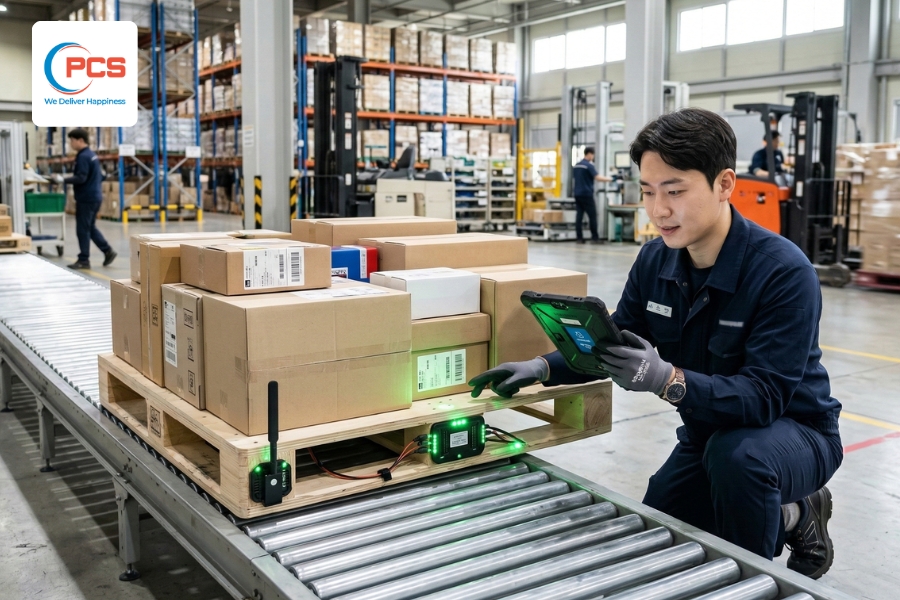
Smart Pallets integrate modern sensor technology to track cargo location and condition in real time.
2. Detailed architecture of the Smart Pallet and Internal Technical Components
To understand what a smart pallet is, it is crucial to recognize that it is not merely a block of plastic or wood with an added chip. It is a sophisticated, synchronized system designed with multiple technological layers.
2.1. Durable manufacturing materials
The majority of intelligent pallets today prioritize virgin HDPE plastic or Composite materials. These materials are chosen because plastic allows radio waves, such as those used in RFID and Bluetooth, to penetrate easily. Furthermore, they offer high durability, are moisture-resistant, and allow seamless integration of waterproof, shock-resistant electronic compartments.
2.2. Multi-functional sensor systems
Depending on specific management requirements, sensors are installed to measure critical metrics:
-
Temperature and Humidity Sensors: These monitor the storage environment for sensitive cargo.
-
Accelerometers: These detect incidents such as drops, heavy impacts, or excessive tilting.
-
Load Sensors: These determine the weight of goods currently on the pallet to control overloading or potential loss.
2.3. Positioning and identification chips
This component functions as the brain of the device. It integrates essential technologies, such as RFID, GPS, and short-range connectivity standards like BLE, to ensure every asset is traceable within the digital supply chain.
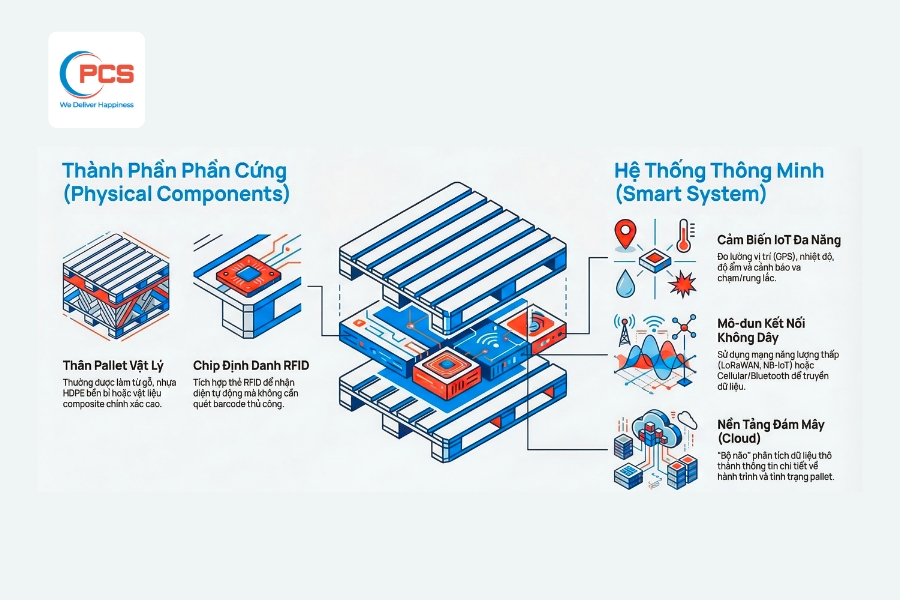
Basic architecture of a smart pallet illustrating physical hardware and its integrated intelligent systems.
3. Common connectivity technologies for Smart Pallets
The effectiveness of understanding what a smart pallet lies in the various connectivity protocols integrated into these units. These protocols are selected based on the operating environment, bandwidth requirements, range, and power consumption. Below are the most prevalent technologies:
3.1. Cellular networks (2G/3G/4G/LTE)
Cellular systems provide precise point-to-point location data for shipments during outdoor transit. This technology is particularly suitable for high-value cargo, though it consumes more energy and requires consistent network coverage.
3.2. Low-power wide-area networks (LPWAN) and LoRaWAN
Technologies such as LoRa and Sigfox provide long-range, highly secure connectivity for tracking large volumes of assets at low cost. A key advantage of the LoRaWAN protocol is its exceptionally low power consumption and its ability to function well in both indoor and outdoor environments. However, it may be limited by data packet size and reporting frequency.
3.3. Wi-Fi and Bluetooth (BLE)
These connections offer higher data bandwidth and perform exceptionally well in enclosed spaces such as warehouses, although their transmission range is relatively limited.
3.4. RFID (Radio Frequency Identification)
This is a cornerstone technology in many intelligent systems designed to support automation. RFID tags allow readers to capture information the moment a pallet passes through a warehouse gate or a conveyor, without requiring a direct line-of-sight scan. This significantly accelerates cargo processing without slowing down operations.
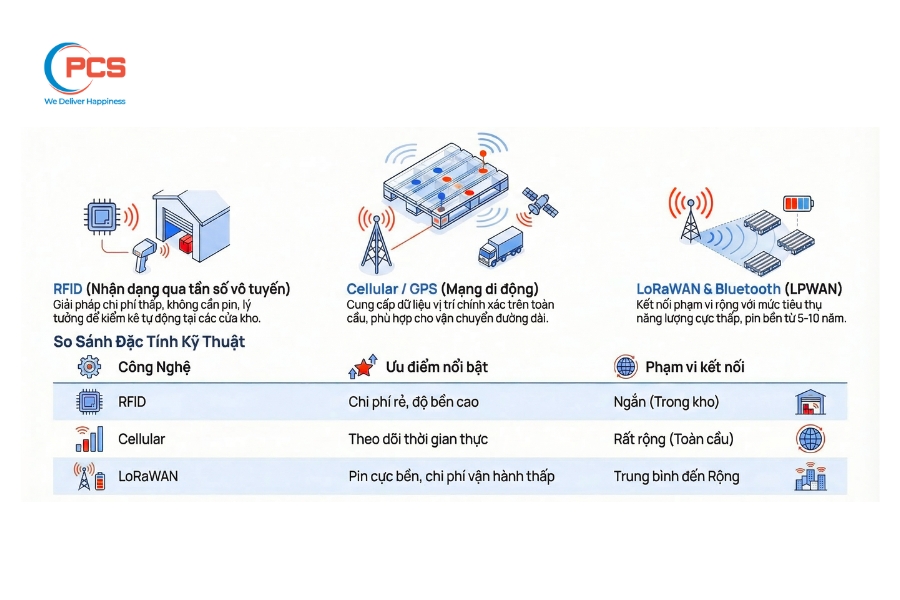
Common connectivity technologies for smart pallets.
3.5. NB-IoT (Narrowband IoT)
A form of narrowband connectivity that facilitates information exchange with minimal power consumption. Utilizing NB-IoT technology can help trackers on intelligent pallets maintain a battery life of over 10 years.
3.6. GPS (Global Positioning System)
GPS tracking modules are often combined with IoT devices to continuously collect and report the pallet's real-time location and movement.
3.7. Satellite Networks (LPGAN)
In remote areas where standard cellular networks offer limited coverage, Low Power Global Area Networks (LPWAN) are used to maintain internet connectivity for the pallet.
A diverse range of connectivity options enables the intelligent system to be flexibly refined for specific use cases, thereby establishing a complete end-to-end tracking data platform for the business.
Mastering these various connectivity technologies allows enterprises to exert absolute control over their goods across all terrains. Currently, you can easily experience this innovation through PCS Logistics' professional smart pallet shipping service in Vietnam, to begin your journey toward operational digitalization.
4. Why Smart Pallets are entirely different from traditional wooden pallets?
To truly grasp what a smart pallet is, one must examine the fundamental shift in how it functions compared to a standard wooden unit. The difference lies in the integrated technology, which transforms these platforms from simple load carriers into intelligent data providers.
4.1. Passivity vs. activity
A traditional wooden pallet is a passive component. Once a shipment leaves a facility, visibility is typically lost. Conversely, a smart pallet acts as a dynamic data source. It does not just carry goods; it also carries vital information and actively participates in the digital supply chain.
4.2. Information blind spots vs. real-time tracking
Conventional logistics relies on manual barcode scanning, paperwork, and phone calls, which are inherently slow and create significant information blind spots regarding cargo location. Intelligent pallets overcome this by using IoT modules, such as GPS and RFID tags, to broadcast real-time location and movement updates without human intervention.
4.3. Condition monitoring capabilities
Standard wooden units cannot perceive their surroundings. In contrast, the sensors on an intelligent pallet act as the eyes and ears of the warehouse. They can record and report environmental factors, such as temperature and humidity, as well as shocks or rough handling during transit, ensuring the cargo's integrity is never in question.
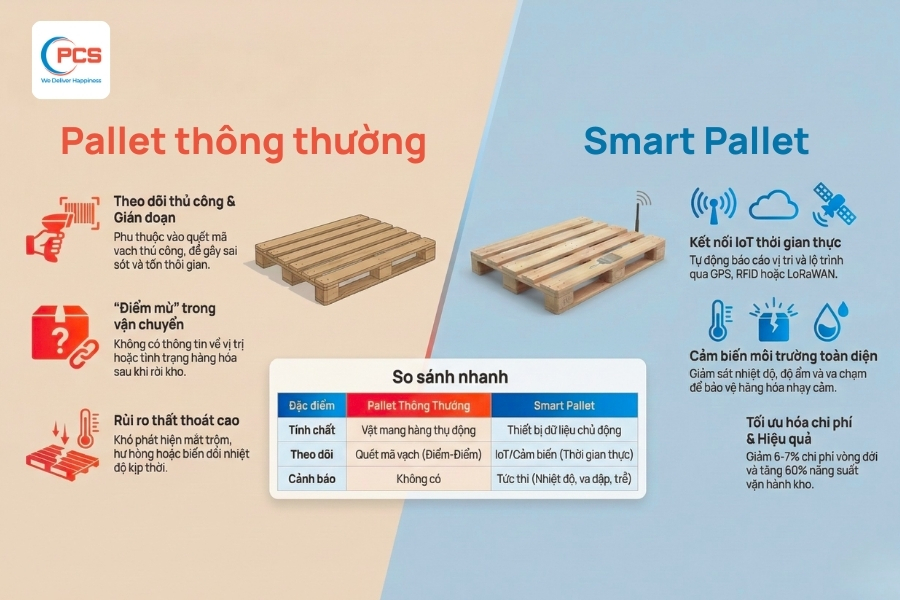
A visual comparison between traditional wooden pallets and data-driven smart pallets.
4.4. Seamless system connectivity
Intelligent pallets transmit data wirelessly to central platforms, connecting directly to a Warehouse Management System (WMS) or the cloud. This creates a digital twin of the physical asset, enabling the system to issue automated alerts for temperature spikes or route deviations and to support faster, data-driven decisions.
In the modern manufacturing landscape, this level of precision serves as the foundation for optimizing enterprise freight services. Integrating intelligent technology into industrial park freight transport significantly mitigates risks, such as inventory discrepancies and production line interruptions caused by material shortages.
By understanding what is smart pallet and its data-driven capabilities are, businesses can ensure that their logistics operations within and between industrial zones remain fluid and transparent. For those seeking a reliable partner, PCS Logistics offers specialized industrial zone goods transport solutions that leverage these smart technologies to protect your supply chain from end to end.